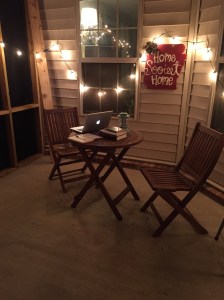
on being almost-27

Tomorrow is my 27th birthday.

I’m not sure where I thought I would be at 27 – it seems like an age with a certain amount of insignificance and monotony in the midst of being a 20-something. As I look back over the past 5-10 years, though, I can see that by 27 I finally feel like I have begun to “grow into myself.” 

High school was rough. I didn’t know how to be comfortable with who I was, and I was constantly seeking my identity in academics and activities and relationships, looking for anything or anyone who could tell me who I was and what value I added. Going into college, Anne Shirley (via L.M. Montgomery) put to words the tension in my mind – “There’s such a lot of different Annes in me. I sometimes think that is why I’m such a troublesome person. If I was just the one Anne it would be ever so much more comfortable, but then it wouldn’t be half so interesting.”

Each fall, I reread the first three books of the Anne of Green Gables series. I get lost in the daydreamy world of Prince Edward Island and the way Anne views the world around her. Each season of the year carries its own beauties and gifts. Every trial or scrape  with it her sense of adventure and a lesson well learned that helps shape Anne into the woman she is becoming. Perhaps this time of year more than any other finds my own heart daydreaming, narrating the world around me as maples and oaks change colors and discover new aspects of their own nature.

As with any other book series, it’s fascinating to observe the ways the author develops the characters and allows them to grow more and more into themselves. The reader gets a birds-eye view as he reflects on what he has read, a position I am learning to take more often in my own life to see how the Greatest Author has been developing my own character – and how I believe He isn’t done yet. “And I am sure of this, that he who began a good work in you will bring it to completion at the day of Jesus Christ” (Philippians 1:6).

In college, I really began to recognize how much I didn’t know about myself. I felt like I had lived within a “box” of who I was expected to be until I was 18, many of those expectations created by myself and how I thought others viewed me. Then college brought a bevy of new relationships and new decisions, forcing me to really identify what I wanted and what I enjoyed. This blatant recognition of not knowing myself acted as a shovel, the tool I needed to start digging into my own self.

“They keep coming up new all the time – things to perplex you, you know. You settle one question and there’s another right after. There are so many things to be thought over and decided when you’re beginning to grow up. It keeps me busy all the time thinking them over and deciding what’s right. It’s a serious thing to grow up, isn’t it, Marilla?”

After 27 years, I finally feel comfortable in my own skin. I feel like I know myself better than I ever have before. I have had enough life experiences and vastly different jobs to allow me to understand my personal strengths and weaknesses and preferences and sin tendencies. While there is much self-awareness that can be learned through personality tests and StrengthsFinders assessments, the most powerful teacher in the subject of “self” has simply been experience. New situations allow me to ask new questions, and both successes and disappointments have contributed to the shaping of my life.

“Oh, Marilla, looking forward to things is half the pleasure of them,” exclaimed Anne. “You mayn’t get the things themselves; but nothing can prevent you from having the fun of looking forward to them. Mrs. Lynde says, ‘Blessed are they who expect nothing for they shall not be disappointed.’ But I think it would be worse to expect nothing than to be disappointed.”

And not only can I see that I know myself better at this almost-27, but I know God better. The more time I spend with Him, and the more I find myself depending on Him daily, the deeper my intimacy with this Author. The more I can recognize His voice as a Writer, the more I notice the patterns and consistencies He weaves into my life. Yet, at the same time, I find that there is so much more that I don’t know about Him. The cliche proves true that “the more I learn, the less I know.” I am more keenly aware of the hugeness of God at almost-27, and thus I am more keenly aware that I can’t ever know it all. I see my brokenness to a greater extent in light of this holy, incomprehensible God, and this drives me to desire a deeper relationship than I even knew possible 5-10 years ago.

In reflection, I see God’s faithfulness throughout my story. Like any good author, He uses each aspect of the plot to beautify the story and to add depth to my character development. He creates scenarios that will aid the development of the story. He foreshadows a bigger picture in the story. Even if the revelation won’t occur for many chapters to come, He can be trusted as an Author.

“When I left Queen’s my future seemed to stretch out before me like a straight road. I thought I could see along it for many a milestone. Now there is a bend in it. I don’t know what lies around the bend, but I am going to believe that the best does. It has a fascination of its own, that bend, Marilla. I wonder how the road beyond it goes – what there is of green glory and soft, checkered light and shadows – what new landscapes – what new beauties – what curves and hills and valleys farther on.”

So as I enter my 27th year and carry new hopes and expectations into what’s in store, I am grateful for the character development God as Author has worked in me. I fully believe that He is sovereign over this story, and He can see the bigger picture of chapters to come that I won’t understand from where I am now. But, as Anne Shirley does, I am seeing the beauty of where I am now and content with the understanding I have been given up to this point. In another ten years, I expect to look back and see how much I actually didn’t know at almost-27.
walking through autumn

Autumn is such a paradoxical season in comparison to the rest of the year.

Don’t get me wrong – it’s my favorite. October holds the key to my heart, and I could pretty must camp out on my front porch and just listen all day to the sound of the wind chasing dried leaves across the sidewalks. When we were dating, I taught Eric to notice the scent fall carries with it. Not the pumpkin spice and apple cinnamon candle scents we all have filling our homes; it’s more akin to the married smell of dirt and sun-dried leaves.

But there is a marked difference between fall and the other three seasons of the year. Spring and summer are all about growth – what’s in bloom, what to plant, what new projects to start. We enjoy the vitality of the world around us during these months, everything seeming to be bolder and brighter and alive. And winter holds herself with a silence eagerly anticipating the coming spring and summer, holding faith that the world will be green once again. Chosen plants for the holidays are evergreens and poinsettias, things that live through harsh temperatures or lower amounts of sunlight.

But in autumn, we celebrate death. 

We earnestly desire for the trees to slowly lose life in their branches, the leaves changing hues in response to the dying in their veins. Foliage fades from green to yellow to brown as we excitedly watch from our windows or on morning walks. What is this inconsistency in perspective at this time of year?

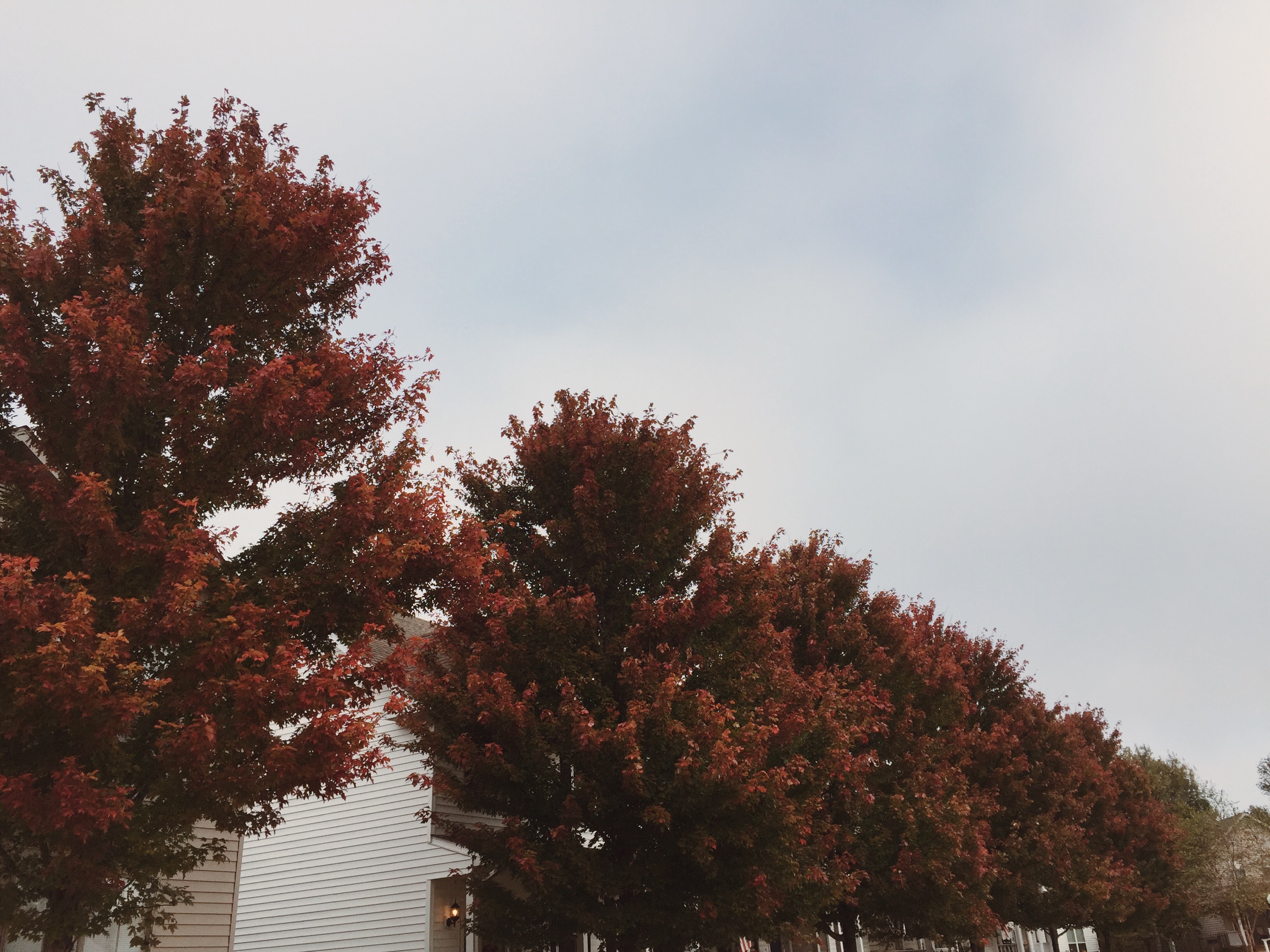
There’s something about how these trees die — they die well. They die in the best way possible, waving their multicolored branches in the afternoon sun as if showing off one to another who can die most vibrantly. They die slowly, evidenced by the maples in front of my house whose lower branches hold bright spring green leaves while the upper branches hold crimson and cherry tinted ones.

Ultimately, we can take joy in these deaths because we know their death is not the end. As the leaves let go of their branches and float to dirt,  we can savor the blissful crunching under our feet knowing that there will be new ones in their place next spring. This death makes way for new life, so we are able to enjoy this season. We don’t dread what spring will be like without these leaves. And maybe this is the secret to dying well – to hold the perspective that something new awaits, that the story is not over. 

While I eagerly await October each year, I admit I am less excited about the experience of death in my own life. As I think about death – to self, to desires, to plans, to expectations – I am not sure that I can say I typically go out with the same fanfare fall does. I cling to those leaves, my dreams, dreading the changing colors and, worse, the loss altogether. Autumn is all about the process, and we find beauty in her process, but so often when it comes to our own lives we want to rush the process and be at the end result.

As I look at the trees, which yield to the course of nature God has established, I wonder of my own life –

Can I die well?
Let go of what I hold as “mine”
Watch it change colors, then wither
(There’s beauty in that process)
Then let it go altogether
to drift freely down
And I, to contentedly stand bare
Anticipating another to take its place in time
A new leaf
Green and whole and bearing fruit

I think we dread death in our lives because we focus on the present crisis instead of the present beauty, and with that we forget the coming spring. We doubt the goodness of God in our losses and our disappointments, fearing if we let go of this we will be stripped forever. We forget that He promises to make all things new, to work out all for good, to fulfill the plans He has for us. And we don’t realize the beauty He creates as we surrender to Him and walk through the process of dying.

This fall, as I bask in the glorious weather and the grandeur of the world around me, I want to be drawn to the heart of God and reminded of His good in my own deaths, in the things I am slowly letting go of so that I may hold more of what He has for me. The story is not over, and new fruit will be produced in time. But for now, I want to enjoy the present beauty He brings even in walking through my own autumns.

a new understanding of how to be tough

I have never been the girl who was afraid of spiders.

At some point in my growing up years, I began to value being tough. I played football or basketball with the boys at recess (including tackle football, much to my dad’s dismay), I refused getting a shot at the dentist and dealt with the pain of a cavity filling, I avoided crying in public, and bugs became objects to smash, not flee.

One of my summers as a camp counselor, my cozy little cabin had a problem with daddy longlegs. All of the cabins were set up around a gravel road, and while I was in the culdesac with several other cabins, mine was set slightly more into the trees, so I suppose the creatures found our rustic home an easier refuge from weather, the screen door hanging just slightly off flush to give them a tiny little entrance.

On the first day of each new camp session, I would tell the girls that our cabin had pet daddy longlegs, that they didn’t need to be afraid but just needed to grab visitors by one of the spindly legs and toss them outside. Sometimes we would name them and scold them for continuing to come back. By the end of the week, even the most prissy of middle school girls would be flinging the bugs outside. I have several memories even of waking up in the middle of the night with the distinct feeling that delicate feet were strolling across my face.

But I was tough, and no three-inch, eight-legged bug was going to bother me.

In reflection, I have taken this approach to my life in general.

I am not sure when it started, but I have always seen fear as a weakness, and while I don’t judge you for your fears or think you are weak, I hold myself to some higher standard, that I am not allowed to experience fear for what the implications would mean in my character.

Recently I was asked about what scenarios trigger my fears when I think about pursuing dreams and calling. I claimed that I couldn’t relate to the question – that I had none. Then, as I started processing, I realized I do have fears – but I communicate them by using words like “struggle” or “obstacle.”

I don’t want to call it a fear. I like to control what I communicate and how others understand what I am walking through. I typically open up easily and embrace being vulnerable, but even that has an element of control to it. I end my confessions stating that everything is okay and I know God is sovereign, yadda yadda – even if I am struggling to connect that head knowledge to my heart.

It’s even less about putting on a tough front for others to see – I think it goes deeper into how I want to see myself, what perspective I use in my thoughts and how I control what I think is true about me.

The word “fear” invokes a sense of helplessness. However, when you phrase it as a “struggle,” that sounds like something you can fight against, that you can defeat. I like the idea of fighting. I don’t like the idea of being needy, of not knowing what to do next or not being able to accomplish what I put my mind to. I want to do it all, I want to be capable, I want to be tough. But, as Christians, that’s not what is expected of us or even how we should desire to live.

Susie Larson wrote, “Sorting through our fears and insecurities is essential to the process of maturing into a woman of significant faith. We give the enemy opportunity to trip us up again and again when we refuse to deal with our fears and insecurities. We miss out on the redemptive life when we shove our fears below the surface and put on a fake smile.” I don’t think I even realized that my smile has moments of falsity to it, that below the surface there are times when I am not okay and when I am helpless, but I am ignoring that feeling and convincing myself that I am confident.

I don’t know if you are like me and you often try to mask your fears by figuring out what you can do to ignore them or conquer them. Maybe you are really in touch with those things and you thrive in your dependency on God. I wish I could say that was me, but so often I want to have a relationship with God and walk alongside Him, but fight my battles on my own. I feel like that should be the mark of my spiritual maturity, that I have learned how to overcome. But the success of my battles is ultimately dependent not on my efforts, but on my training in allowing it to be God’s efforts.

We can’t deal with our fears on our own. We can’t see our struggles as something to prevail over by working harder or suppressing feelings of anxiousness. My toughness is less dependent on my abilities and more dependent on how I rely on God in the midst of something I can’t control. 

Let me restate that.

When I confess that I am out of options, when all I can do is fall to my knees and ask God to step in — then I rest in Him while He is fighting for me — that is toughness. Resilience to believe in what He is capable of and being okay with having no control myself.

I have always feared the idea of being needy, but I am now learning that I need to fear not understanding my need.

Praise Him Who fights for me, Who is patient with me, Who has grace waiting when I find myself exhausted and defeated.

marriage letters: on unmet expectations

Dear Eric,

Early on in our relationship, our primary disagreements were on unmet expectations. I expected, when you were coming to pick me up from church, that you would arrive 15 minutes before it started so we could get there right on time, maybe a few minutes early to mingle and find a seat. You expected that picking me up at 5 till 9 and walking in 8 minutes late was the best approach. Needless to say, we had a lot of silent, tension-filled car rides on Sunday mornings.

After getting married, we found that we had different ideas on how to spend a Saturday.You enjoy sleeping in a little, taking the morning slow, savoring the pleasure of not having anything to do. My internal alarm clock won’t let me sleep past 7 am, so I am always out the door at 7:15 to go grocery shopping, then coming home and clean and organize. No such thing as “slow” in my vocabulary.

Then there were the date nights. You would so lovingly plan out every detail of our evening, but a disconnect in my expectation of eating first versus your expectation that dinner could happen later would stir up tension and frustration (until you caught on that I don’t function well when I’m hungry).

So – out of necessity – we started communicating expectations. I think this has been one of the best practices in our marriage, one of the areas I have seen the most growth for us. Very rarely do we miscommunicate because we take precautions to talk about everything.

Each Friday night, we ask, “What do you expect for tomorrow?”
Every Sunday while driving home from church, we talk about how we want the day to look.
Throughout the week, we talk about which evenings are free and if there is anything the other wants to prioritize.

Plus we know each other well enough to know how the other usually wants to spend free time.

Recently, though, I have recognized more significant unmet expectations that we are still working through, ones that additional communication won’t repair.

It’s you with your job – working in a corporate office is not where you expected to be four+ years after graduating. You question what you are doing and why you are there and if there is any hope for something else. We dream together about grad school and ministry and what it will take to help you thrive, but it all seems just out of our reach. I sense you fighting bitterness against the life you wanted but don’t have, the disillusionment of being a twenty-something. You want to have it all figured out before we have kids, before we enter a new season, but it doesn’t seem to be happening the way you expected it would.

But unmet expectations are also held by that idea of entering the next season. The work and the waiting in starting a family was not what we expected. I am still processing what it means to not have control over this timing while finding myself each month wondering if it is time. We haven’t been in this new journey for very long, and I know it’s not time for me to be frustrated yet, but it’s been long enough for me to realize that I still struggle with not getting what I want when I want it. With unmet desire and with plans I don’t get to plan. And unlike in our marriage, God doesn’t sit down with me and discuss His expectations or His ideas. He simply sits with me, lets me talk, and asks me to trust Him.

To be honest, I think we fear asking God for specific things because of past unmet expectations. We fear setting deadlines and praying big prayers – not because we don’t believe God is capable, but because we deep down don’t believe He will answer.

We can’t fix these unmet expectations on our own, and we have to learn how to handle them just how we had to learn how to do with the little things in marriage. We are processing with words and with tears and with presence. Instead of a disconnect, our unmet expectations are pulling us together. And that might make all the difference with whatever we will encounter in the future – that we are a team. We are doing this as one.

Starting today, let’s both work to believe God for big things and to grow together as we ask for more faith. Life may not meet the expectations we have set, but I’m grateful we get to work at it with each other, rerouting our plans and rearranging our desires to match what the Lord has for us in the present.

You are the best teammate, and the Lord exceeded my expectations when He gave me you.

Love,
me.

giving up – in a good way

I carry a great weight.
I have a feeling that you might carry it too.

I feel it in my skin. I know that’s vague, but my skin has this heavy feeling. Each breath takes additional energy these days for the rise and fall of my chest, pushing through what seems to be holding everything down.

I sense it in my smile. While usually genuine, I have moments when I release the smile and realize it was forced, a mask to not just convince those around me, but to convince myself that everything is okay.

Why do I have to convince myself of this?
Do you ever find yourself thinking, “I am a failure” or “I can’t handle it all”?
Are you afraid that you are one big fake, and someone is going to find out sooner or later?
Please tell me I’m not alone.

I never consciously tell myself I am a failure. But I know I am wrapping up that one awful word – failure – in colored tissue paper of trying harder and pushing through and attempting to juggle more than I can keep in the air.

And as I try to think back to a time in my life when I didn’t feel this way — I can’t. In high school, I felt lonely, so I spent all my energy trying to meet high standards in school and sports, hoping that would lead to contentment and identity and worth. In college, I saw my grades and my relationships and my ministry as a result of my own striving, leading to senior year burn out and wondering what it was all for, what it meant about me.

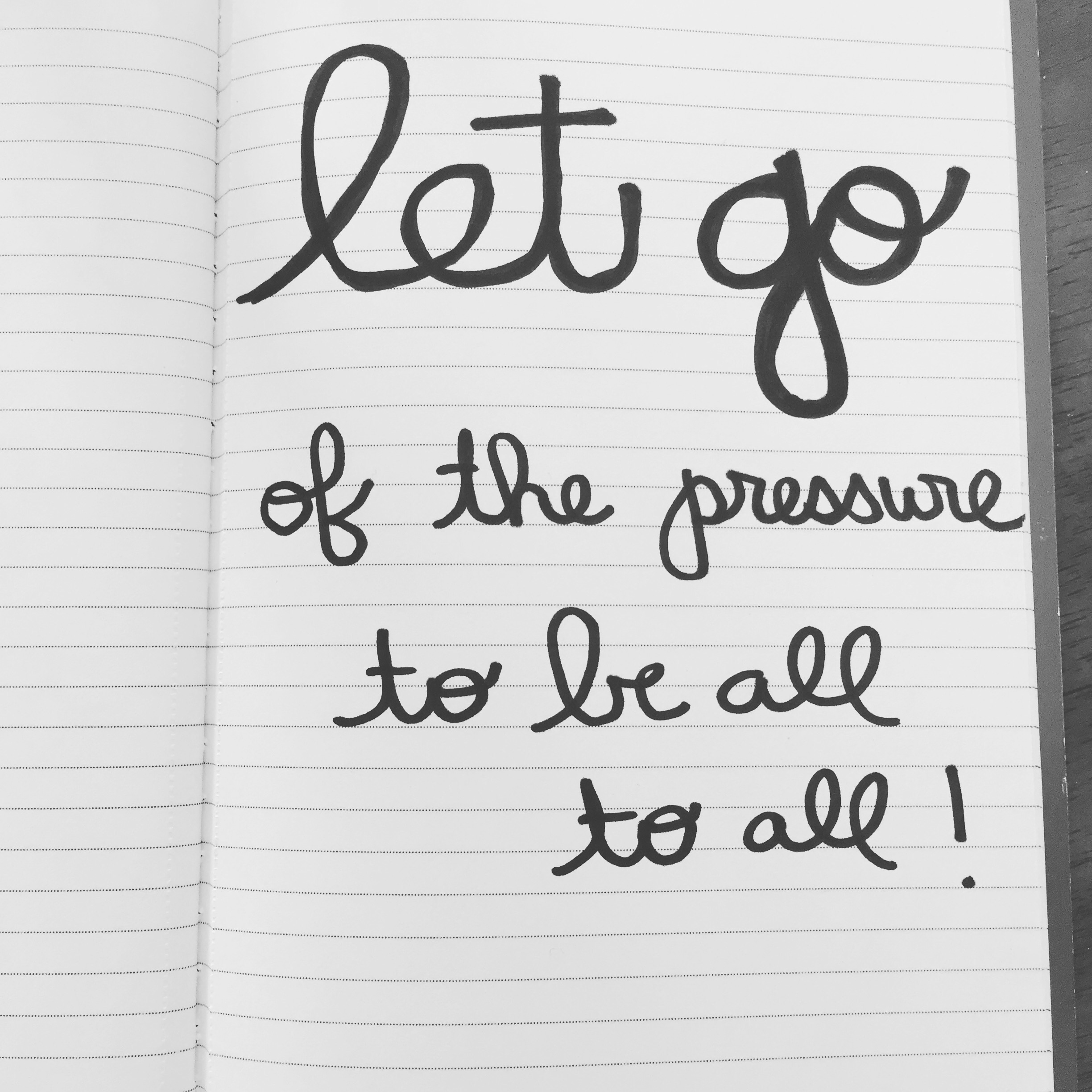
A breeze blows across the patio, and I feel it slowly coax away the weight. I write these words on paper, ignoring the restrictions of lines on the page: Let go of the pressure to be all to all. I see the silliness in that concept – how could someone be all to all? But I didn’t realize that was the weight I was carrying until my pen revealed it in ink. Big and bold and curvy, I trace and re-trace the letters.
I hear God – maybe not audibly, but I hear Him in how my thoughts continue to unwrap this statement. Stop thinking that it’s all up to you – to maintain friendships, to manage your home, to make progress at work. Let go. Breathe out the weight, breathe in grace.


How self-centered is that, to think that I am the one who makes it all happen? “I am the only reason I have friends and those friends feel loved. My efforts are needed to keep the world going round. I am the answer to all of the questions being asked.” Not only is that egocentric, but it is too much pressure for one person to hold. Do you recognize that for yourself, too? It’s okay that you can’t carry it all, but I know you are still trying. No wonder we feel our souls collapsing into depression or anxiety or workaholism or addiction in its various forms.

As much effort as I exert in each area of my life, I feel like I am failing somewhere. I can’t make straight A’s. And I am sick of feeling like I am failing when I am exhausted from trying so hard.

“In Him we live and move and have our being” (Acts 17:28).

Your very breath that indicates life is breathed because of Him in you. Even the most basic of life requirements is not something that you can accomplish on your own – and that should bring freedom.

So I am making the conscious decision to give up. To confess to the world and – more importantly – to myself that I cannot do it all. I want to relish the grace available in this confession. I want to immerse myself in that grace like a child who has just raked a yard full of leaves together for the sole purpose of scattering them with that one jump. It doesn’t quite make sense, as she will probably have to rake them again, but it’s not about efficiency or logic. The beauty of grace is that it doesn’t make sense, but it is a gift meant to be enjoyed.

I am going to breathe more easily this week. I am going to surrender to my own limitations. And I am going to jump all in to grace, watching leaves fly and laughing in the child-like freedom found in grace.

what freedom feels like

IMG_5289I woke up two hours earlier than normal this morning, and after 30 minutes of trying to fall back asleep, I finally got out of bed. The crickets and cicadas are louder at this hour, and the quiet of the world has been begging me to stop and listen. To create space for thoughts and musings and maybe some written words to cling to for the day.


I think most of us crave words in ways we don’t realize. There are words during different seasons that seem to resonate with our hearts – whether it is one that provides hope in the midst of darkness, or safety during uncertainty, or promise when it seems like nothing is going right. It doesn’t even have to be a word contrasting to life; we can fix to words like joy and faith and intentional when we feel like we are living in those places. These words can come up frequently in every day conversations or books we read or prayers we find ourselves praying. They have a way of following us around, revealing themselves when we need a reminder or when we are looking for affirmation. We seem to love emblems and themes we can recognize in our lives – maybe it helps us feel that there is a purpose in this world, that there is a Master Planner Who is in control and working all things according to His design.

The crickets and cicadas have been a theme for me during these past couple of months. I hear them at all times of the day in all different states of my heart – rest or chaos. When I think about these insects, I find myself grateful for the ways the world is humming around me and following a pattern of seasons even when my life seems all over the place. I hear the chirps and am compelled to sit and think and be. I am curious by the ways I can’t see them, yet their voices come together in a way that you can’t miss what they are singing.

Another concept that seems to follow me around is freedom. I am finding this word constantly, or maybe it is finding me – in my conversations, in the books I am reading, in the Scripture I am processing, and in the goals I am recognizing for myself as a writer and as a person.

Freedom.

With this word comes its own set of questions. What really is freedom? How do we get it? How do we know if we are living in it? Is there something I am not experiencing freedom in, or it is just a word that I need to savor and store for a later time?

I love the way Toad describes freedom in The Wind in the Willows:

Sitting up, he rubbed his eyes first and his complaining toes next, wondered for a moment where he was, looking round for familiar stone wall and little barred window; then, with a leap of the heart, remembered everything–his escape, his flight, his pursuit; remembered, first and best thing of all, that he was free!

Free! The word and the thought alone were worth fifty blankets. He was warm from end to end as he thought of the jolly world outside, waiting eagerly for him to make his triumphal entrance, ready to serve him and play up to him, anxious to help him and to keep him company, as it always had been in days of old before misfortune fell upon him.

Now, Toad is an extremely narcissistic character in the story, so his view of freedom is completely wrapped up in how the world can best benefit him and serve him. He has escaped from jail, and he thinks the world is now open and ready and waiting for Toad to return to it. And I have a feeling that Toad is spot-on when it comes to what freedom feels like, but it wrong when it comes to what it actually is.

I was talking with a couple of college students last week about the Gospel, and as we read Ephesians 2:8-9, I found myself talking about this concept of freedom.

For by grace you have been saved through faith. And this is not your own doing; it is the gift of God, not a result of works, so that no one may boast.

I see freedom illustrated in this grace – that the Christian life is not up to us. Our salvation is not reliant on our ability to earn it and achieve it. Our joy is not a result of trying hard enough to live in a perpetually happy state of mind. The hope we have in eternity does not depend on what we can do. All is a result of grace. And the weight I hold in myself comes off.

I think of freedom in the way that Christian probably experienced it in The Pilgrim’s Progress.

Now I saw in my dream, that the highway up which Christian was to go was fenced on either side with a wall; and that wall was called “Salvation”.

“In that day shall this song be sung in the land of Judah; We have a strong city; salvation will God appoint for walls and bulwarks.” Isaiah 26:1

Up this way, therefore, did burdened Christian run; but not without great difficulty, because of the load on his back.

He ran thus till he came at a place somewhat ascending; and upon that place stood a Cross, and a little below, in the bottom, a sepulchre. So I saw in my dream, that just as Christian came up to the cross, his burden loosed from off his shoulders, and fell from off his back, and began to tumble; and so continued to do till it came to the mouth of the sepulchre, where it fell in, and I saw it no more.

Chills run across my arms and legs as I reread those words. As he ran to the cross, ignoring the weight of what he was carrying, it just fell off.

This summer, en route to Alaska, I found myself doing what I hoped I would never have to do: running through the DFW Airport with a 65L hiking pack strapped across my shoulders, my back, my waist. Honestly, it wasn’t so much even running as it was hunched-over waddling at half speed. Or a slow-mo scene. If I were watching myself, I would have said it was unattractive and comical, so you have permission to laugh. It was even worse when I didn’t make it to my gate in time and I burst into tears, mostly from the stress of running across the airport and the disappointment in missing that flight – but let me tell you, I was in pain.

When I try to picture what initial freedom looks like, I picture, like Christian, running up the hill towards the cross, eyes fixed solely on that destination, and the Lord loosening the multitudes of straps holding that pack to my body. The feeling of the pack slowly slipping off and having no concern for what is happening except that I am getting closer to the feet of my Savior. What joy, what gratitude would result from such an encounter!

I don’t know what burden you might be carrying right now, what is weighing you down and jailing your soul. Or maybe you aren’t carrying a pack at all – the straps have already loosed and fallen off, but you have forgotten the weight of the pack and therefore the weight of gratitude for the One Who removed it.

I think I am still trying to figure out exactly what freedom is for me — but I know what it feels like.

stepping over rocks and roots

As a child, when I wanted to write, I just pulled out a pen and my notebook and started a new story. I didn’t spend time thinking about how the plot should progress or what would be a strategic way to introduce new characters. I simply started writing and let the words take me into the story.

My best friend Anna and I wrote a book together in third and fourth grades. We filled a whole journal with stories and illustrations about two horses and the family who owned them. We would pass the book back and forth so I could put in words and she could put in pictures. Sometimes, that’s how I would spend my recess time (when I wasn’t playing touch football or basketball with the boys)- seated at a picnic table with a pen and my ideas for what new adventure Penny and Misty would go on.

Now, as a grown up, I spend too much time thinking and planning and crafting. I want to write, but it takes so much more effort. I don’t know if my imagination has drifted into more of a need for structure, or if I have just developed a habit of over-thinking. I want to write, and I find it life-giving, but I spend so much time being overwhelmed at the idea of pursuing writing instead of just doing it.

I think adults are like that in general with their dreams. We are told as children that we can be anything we want to be. Even in college, we daydream about the crazy things we could do once we graduate. But something happens within the season of getting a job and starting a lease or mortgage and paying bills and getting married where dreams seem unobtainable. No longer do we feel like we can do anything – decisions have to be made with strategy and budget considerations and logic. One can’t just quit his job to move without a new job already set up in a new location. You typically can’t take a month off to embark on an epic road trip. Bucket lists have to be accomplished within the span of weekends or vacation days. And the dream of writing outside of this blog one day seems so daunting that I don’t sit down to just start writing.

Graduating college and becoming an adult used to carry with it this hope of freedom, of finally being out of the confines of school and studying and having your next step planned out for you. If I am being honest, though, in the past four years since graduating, I have felt more trapped in the confines of adulthood. My next step may not be planned out for me, but I find I am less willing to take risks. I like to think I have an adventurous and brave perspective on life, but it is often more in my daydreaming than actually carrying out those dreams.

I also like to think I can come up with all of the answers I am looking for, especially within the span of a blog post. If I just write long enough, maybe my fingers will subconsciously type all that I need to know. I like the idea of my writing being like a guided hike; I want to be just a few steps ahead and encourage you in what I have learned on the trail so far (often thanks to mentors and guides who are in turn a few steps ahead of me).

As I have been pondering these questions, though, all I can figure out is to look at the next step – to hike on without knowing exactly how to get to the end of the trail except to step over one rock or root at a time. 

My rocks and roots to pursue writing involve creating space to write, savoring words I love, and learning to be more honest with myself and with others. Maybe for you it’s a new job, and your next step is to start a brainstorm list of what skills you have and what things you are passionate about. Or, if you want to take a trip, start saving and collecting maps and travel tips. Whatever your dream is, don’t get overwhelmed by how unattainable it seems. Simply figure out the next attainable step.

Don’t let the length or the difficulty of the trail scare you away from trying to hike it. And I am preaching that more to myself than to you.


{What does it look like for you to pursue dreams? How do you keep yourself from being caught up in the boundaries we create for ourselves as adults? What does freedom truly look like?}

the beauty in submission

Nature hums and chirps around me this morning. The days are hot here, and the humidity weighs on you like a wool blanket, but morning shade reminds me of why I love summer. Our little town in the Ozarks sleeps in during these months, enjoying the quiet opportunity before the rush and bang of late August, the start of school and football and college students returning. I loved this quirky town as a student, but I know I love her even more as an adult.

Last week, Eric and I walked past a man wearing a tie-dye duster sweater who was walking a goat on a leash. We then accidentally attended a (rather upbeat) wake at a local combination coffee shop and craft brew bar. This morning, families ride past me on the trail on their bicycles, and a group of retired men laugh over morning coffee together. Soon, the whole town will be decked out in red and white, and random calls of “Woo Pig” will echo in the streets downtown. Sweet Fayetteville surrenders to seasons like a lazy canoe on the river floats along where it is taken.

“Surrender” and”submission” don’t always have to carry a negative connotation. There’s a coming beauty in the release of the now-green leaves to the death awaiting them, to the orange and gold turning and falling.

Often, though, when it comes to relationships, we cringe at these words. With them we hear whispers of “defeat” and “loser” and “weak,” and in a culture obsessed with equality and fairness, the concept of submission seems irrelevant or – at best – a necessary evil. Yet the world around us works best when there is submission. There is freedom for a sailboat at sea when it follows the rules of the wind and the mast and the rudder.

In my marriage, I have seen the beauty of submission at work. I have experienced the freedom we have found as a result of yielding and preferencing the other – and, ultimately, in surrendering to Christ. I have several friends whose marriages are struggling right now, and I think that is totally normal. Marriage is hard; you are trying to get two broken and selfish people to work together in the day to day of life. But one of the things that has made the difference in our marriage recently is a greater understanding of submission, both for me to Eric but also for me to Christ and for Eric to Christ.

Submission is not me losing every battle – the relationship within marriage is not a battle in any sense. Eric and I are on the same team, and he is the “team captain” with God as our “Coach.” I can follow Eric’s leadership for our team because I know he is following the leadership of our Coach. Elisabeth Elliot wrote, “The world doesn’t run without authority. Somebody has to tell us what to do. The question is not who he thinks he is but whom does he represent.” When Eric is leading out of his relationship with God, I am not looking to my husband as my ultimate authority but to God. When Eric is not walking closely with Christ, or is in a “dry” season in this walk, my response is not to usurp his role, but instead to pray for him and encourage him and affirm him. Life change happens more often through positive words than negative and critical comments. When Eric knows I believe in him and trust him, he feels a deeper pull to step up and make changes.* When I criticize and demean his leadership or communicate doubt in his character, he gets paralyzed by discouragement, and our unity is broken.

Submission is not me losing my personality or my strengths and giftings. I have always had a natural bent towards leadership, and was often told growing up that I needed to tame that side of my personality because it would come across too “strong” for a man to want to pursue me. However, my Eric tells me that my strong personality was an attraction to him, and he still praises me for how the Lord uses me in leadership capacities. I, of course, can tend towards an unhealthy practice of this, and I recognized that even more when I got married and found myself nagging and criticizing and correcting in desire of still having some sort of control over our relationship. I think the Lord has developed in me a healthier view of leadership through my growth in submission. While I am still constantly fighting my fleshly desires, I lead differently in situations where my role is to lead, and I am able to trust in situations where I am not the leader. In fact, my growth in submission works in conjunction with Eric’s growth in leading and rejecting passivity, and it’s been a beautiful picture of the work of the Spirit to sanctify us both in our sin tendencies.

Ultimately, though, submission is not about me. It’s about God. I am submitting to God through Eric. I am trusting God when I trust Eric to make decisions for our family. Self-centeredness is what makes submission so difficult. “In humility count others more significant than yourself. Let each of you look not only to his own interests, but also to the interests of others” (Philippians 2:3). When we live by this in our relationships, submission becomes less about absolute authority and more about loving another well – in marriage, loving your spouse well. As believers, we are all called to live this way, whether husband or wife, so when we are walking in the Spirit, this will be how we treat our spouse. We aren’t grasping at strings we can pull or accomplishments to hang over the other person’s head. We aren’t worried about getting the better end of the deal or having things our way. And there’s a sort of joy in letting go of those things.

In fact, we should discover joy in the grace found in inequality – “home is a place where we ought to be allowed to be unequal, where everyone knows everyone else’s inequalities and knows, furthermore, that it is the inequalities that make the home work” (Elisabeth Elliot). In love, you desire the best for someone, and in love you naturally serve them. You don’t make it about whose turn it is or complain about how much they did versus you. I know Eric’s weaknesses, and I love that I complement those, so I want to serve him in those ways, and I rejoice in the ways he serves me in my lack.

Submission is a constant area of growth for me, and I promise we don’t have it all together in our marriage, but I am learning more and more what it looks like to trust Eric’s leadership and love him well. In return, he is freed to flourish in his role as a husband and leader, and when he is flourishing I find that he in turn loves me well. It has the potential to be an endless cycle of loving and serving each other, and this keeps us unified so that the battle of marriage is fighting together against the trials of this broken world.


*caveat : this can become manipulation if your heart isn’t right or if you use it as a way to control your husband

marriage letters: on home

Dear Eric,

We once thought we would get to work together – back when we thought we were joining a ministry, the both of us. We had worked together once before, a brief period at the same company. Driving to work together daily was fun, but also convenient since we only had one car. And the time we had to take that one car to the shop to be repaired, we rode our bikes to work. There was something so sweet about taking a break during the day to grab something to drink and meander up to your desk just to say hi and kiss you on the cheek. If I had a bad day, I could send you an instant message and ask you to meet me in the break room, and you could just hug me for a minute, reminding me that everything was going to be okay.

We dreamed about working together not just for convenience and kisses, though. We loved the idea of working for the same purpose, of being united together in our daily goals and plans and spent energy.

Yet that’s not what happened. We work on opposite sides of town and spend our energies differently, me for college students and you for pet treats. Once again, we only have one car, so thank goodness for your motorcycle to allow for our separate schedules and transportation needs.

Despite our different locations and goals and tasks, though, I find that we do still work together. Our place of unity, of working together, of shared vision, is our home. Home is where we are a team.

We’re still in the “newlywed” stage of home ownership, where people are frequently asking us how we like our new house. We usually smile and talk about how fun it has been and what current projects we are working on to make it our own. You have been building that screened in porch, and even though it is taking longer than you hoped (definitely not a weekend project), I am super excited about how it is turning out. I’ve been trying to brainstorm new ideas for our bedroom and the office, and there are still some boxes nagging at me from the upstairs closet. It’s been so fun to work together to tangibly create “our space” and decide what we want to change or keep.

But our new house isn’t just special to me because of the porches or the walk in closet or the spacious kitchen. The working together I am thinking of is not only in the physical and tangible. The significance of our house is the space of home, the space for us to create together, to work together, to live together. It’s where we engage in ministry and community. It’s where we battle for our marriage and for our friends’ marriages and for our families in prayer. Home is where we will one day work together (and learn together) in raising our own family. As Anne Morrow Lindbergh wrote, “The web of marriage is made by propinquity, in the day to day living side by side, looking outward and working outward in the same direction.” The side by side work is my favorite, because you are the one by my side.

Let’s keep spinning this web together.

Love,
me.

——————————————-

Each month, I write a letter to participate with Amber Haines in the “Marriage Letters” series on her blog. I love getting to develop this practice of blessing my husband and our marriage. You should also check out Amber’s most recent marriage letter and the others that are linked up to her post.

what the sea teaches

An unusually cool breeze drifts across the patio, and I find myself pausing to observe the world around me, Nickel Creek strumming their way through my headphones to provide soundtrack songs for this July morning.

Just a couple of hours ago, an intense feeling of loneliness and discouragement came out of nowhere and seized my heart. I started scrolling through my Instagram feed, just to see what has happened in the past 10 hours (during most of which the world was asleep), and as I put down my phone I felt left out. I suppose people I love are scattered over lots of places right now, and when I am not with them or even just not doing my own exciting thing, I somehow feel like my life is less. Even though just six weeks ago I was the one posting images and statuses from my own adventures.

Cyclists and joggers pass me on the bike trail. Murmurings of business meetings and friends catching up over coffee surround me, and my eyes move from people-watching to the dance of the tree branches above me. Words from Anne Morrow Lindbergh marinade internally, slowly finding their way into my own life.

     And then, some morning in the second week, the mind wakes, comes to life again. Not in a city sense–no–but beach-wise. It begins to drift, to play, to turn over in gentle careless rolls like those lazy waves on the beach. One never knows what chance treasures these easy unconscious rollers may toss up, on the smooth white sand of the conscious mind; what perfectly rounded stone, what rare shell from the ocean floor. Perhaps a channelled whelk, a moon shell, or even an argonaut.

But it must not be sought for or–heaven forbid!–dug for. No, no dredging of the sea-bottom here. That would defeat one’s purpose. The sea does not reward those who are too anxious, too greedy, or too impatient. To dig for treasures shows not only impatience and greed, but lack of faith. Patience, patience, patience, is what the sea teaches. Patience and faith. One should lie empty, open, choiceless as a beach– waiting for a gift from the sea.

I confess – I like the digging. I like the feeling of tired hands and dirty nails, the things that prove that I worked hard to earn a reward. I am high performance and crave A+ papers and gold stars and pats on the back.

So quickly, though, I find myself exhausted. I am digging for significance, for meaning, for a sense of community in my daily life, and while I like the control of being able to earn my way, it’s not life-giving. I feel like I am digging and proving I am good at digging, but at the end of the day the things I have to show for my efforts are burnout, unmet expectations, never enough.

Being able to receive the gift from the sea requires one to just be present at the shore, to set up a chair or a towel and lather on sunscreen and just watch for what washes up at your feet. Patience, patience, patience, is what the sea teaches.

Isn’t that the beauty of a gift, that it is freely given, that you don’t work to earn what someone wants to place in your hands? Isn’t the concept of a gift where we get our understanding of grace? Isn’t there a certain joy in discovering a gift, a joy that cannot be found in the working for it? 

As I processed my digging efforts, I realized I needed to get rid of the spades and buckets I have been using to dig. I temporarily removed Instagram, Facebook, and Twitter apps from my phone. Not because I am super spiritual, as I often feel others are when they make that choice, but because I am not disciplined enough to leave those digging tools just sitting in the sand next to me, and playing on my phone is where it normally starts. I will need them soon when school starts up and college students are back in town, but for the next three weeks, I am going to be present. I am going to sit at the shore and enjoy the salty sting of waves against bare feet, the warmth of rays, the grit of sand. I want to have face to face conversations to hear about friends’ travels, and I want to have phone conversations with those long-distance. I want to spend my evenings reading books, not comparing the activities of my day to others’ own. I want to see my life not through a filtered image with a picture that has been perfectly staged, but through the daily grind of boring and basic but beautiful.

The ever-wise Elisabeth Elliot wrote, “We accept and thank God for what is given, not allowing the not-given to spoil it.” Today, my place to offer thanks is a quiet, uneventful one. But if the trees can dance despite their roots keeping them stuck in one spot, I can too.

So while I write this from the landlocked Ozarks, I am learning what the sea teaches. No dredging of the sea-bottom here. Patience, patience, patience. Patience and faith.