the risk of a fickle march

image1Hope is a risky thing.

The buds on the trees have been slowly developing over the past few weeks – so slowly that you might not have noticed them until now, when their colors start to fade into focus.

Last summer, we planted a “Jane Magnolia” tree – a tulip tree – and I have been eagerly anticipating spring when pink and white blooms would present themselves for the first time.

Last fall, we planted daffodils, and my insides have become giddy as the bulbs have recently bloomed to welcome spring. This is our first March in our new house; next month will make one year since we moved in, and I feel that our own daffodils blooming is the last piece of the puzzle to make this house our home. Daffodils have always been my favorite.

With a milder winter, I certainly haven’t complained about the lack of snow, but I have suspiciously resisted from calling it an early spring. March snows are always a possibility, and I fear for the state of the blossoms peeking out from under their covers. I don’t want to get my hopes up that winter really is over, because I fear being pounded with inches of snow and having to dig out my puffy coat again.

That has to be one of the worst feelings in the world – getting your hopes up for something, and really believing it will happen, only to be thoroughly disappointed and discouraged. It jades us, makes us cynics in a world that is increasingly more welcoming to the cynical and doubtful.

Hope can seem too risky, too naive.

We want to outsmart the things we can’t control, so we hold back from believing in what is possible, suspect that things won’t ever really change, or refrain from making plans because we hate the idea that they won’t work out. We want to be able to say, “I told you so” to cover our disappointment and to pretend that we aren’t hurt.

But if I’m not careful, I will carry this attitude with me all through the month of March, claiming that spring is “too good to be true.” Then April will hit and I will realize that I missed the joy of the whole month – the early bloomers, the budding trees, the grass slowly turning green. The joy of the world preparing itself to reveal life after a bare, windy winter.

I will have missed delighting in the daffodils for fear that they will be killed by a late snow.

“You set your heart too much on things, Anne,” said Marilla, with a sigh. “I’m afraid there’ll be a great many disappointments in store for you through life.”

“Oh, Marilla, looking forward to things is half the pleasure of them,” exclaimed Anne. “You mayn’t get the things themselves; but nothing can prevent you from having the fun of looking forward to them. Mrs. Lynde says, `Blessed are they who expect nothing for they shall not be disappointed.’ But I think it would be worse to expect nothing than to be disappointed.” –Anne of Green Gables

I don’t want to miss out on the fun of looking forward to what’s next.

Often, the anticipation of something is just as fun as actually getting it. Think about a child trying to go to sleep on Christmas Eve, or the planning and packing for a big trip, or the moments leading up to a bride walking down the aisle to her groom. Time seems to move so slowly when you want something to happen, but it’s a feeling that you can’t create unless you are in the situation. The better the thing you are waiting for, the harder the wait. The more you start to doubt that it won’t come. But the rush of emotion when it does come is better than the numbness of never believing it would come in the first place.

I want to live a life that is hopeful, not suspicious. I want to enjoy March for all it has to offer, even if it teeters on the possibility of early spring regressing to late winter. I want to take out my sandals and short sleeves without shame, without worry of what tomorrow might bring.

And I want to be present in my own life seasons of March.

In the waiting for a baby, it’s easy to let the months pile up as reasons to doubt that the future will change. Don’t they call insanity doing the same thing over and over, expecting different results? Yet that can pretty much feel like the journey to get pregnant. It’s discouraging, it’s uncontrollable, and it doesn’t seem to change.

Maybe you can relate in your own season of March, in the wait for a desire to be fulfilled. You start to feel ashamed each time that it doesn’t happen, you begin to quiet your sadness when talking to others, you want to outsmart your hope each month that something will be different. You harden yourself to hope, instead thinking it’s easier to just forget your desire and avoid the pain that comes each time you realize it’s not going to happen.

But I don’t want to live in ignorance of the buds which are starting to unfurl in this season. There’s beauty in those early stages. I don’t want to avoid disappointment at the cost of avoiding the experiences of life – both joy and pain. I want to be present each day in the month of March, not worrying about whether or not the temperature will drop in a week.

Because there is joy in anticipation and fun in the wait. There is something to be valued in the suspense of this beautiful yet unpredictable life, especially as we remember that we have a God Who is sovereign over those details. He tells the bulbs when to bloom and He reminds us that His hand is in every detail of March. We can hope not because it will guarantee a change in circumstances, but because our hope draws us closer to God. He alone holds the power to move us into spring or stay us in the winter, and His purpose in either season is greater than what we can understand.

I know the risk, but I am choosing to hope in the fickleness of March, bringing my hope to His presence no matter what happens next.
admitting when things are messy

I thought I had already picked a “word” for 2016. Something to anchor me to a purpose, a characteristic I wanted to develop, a place I planned to focus in growth.

And, while I still love the word rooted and all that it implies in my walk with God, I think He might be changing the word He wants me to focus on.

There’s this tool called Soularium that we use for ministry within Cru. It is a stack of photographs which you spread out on the table and use to start conversation, typically evangelistic in nature. It’s incredible how students will relate cards to where they wished they were in life, what they think God is like, and how they would describe their spiritual journey.

As someone who loves to think in metaphors, though, I enjoy using these cards to start conversations with others simply regarding where they are in life right now and even for personal reflection in my own story.

As I was using Solarium with a group of students a couple of weeks ago, I came across this card:

FullSizeRender (2)

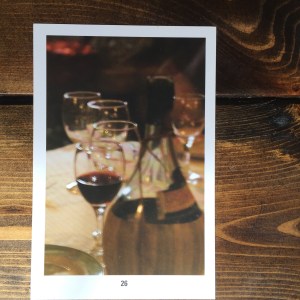
My initial reaction noticed that it was blurry and messy. Maybe from a group of people who have finished dinner but have yet to clean up.

The word messy has come up for me a lot lately, and I first found myself hoping God wasn’t doing that on purpose.

When journaling and praying, I have repeated ideas that communicate feeling “all over the place” and wanting to be able to “get myself together.” I have felt a lack of consistency in so many internal areas and daily disciplines, when I typically feel like I am someone who is a little more leveled out. When sitting down with a counselor several weeks ago, it’s the word that kept coming out of my mouth to describe how I have felt and why I wanted to talk to her. Eric has told me he thinks I am the “even keel” one in our relationship, but I have begun to doubt that role over the past few months.

I don’t like for life to be messy. I like order, control, efficiency. Heck, I have a planner that breaks up my day by the hour so I can quickly see what gaps are in my schedule and how I can make the most of them. While my home is not spotless, it is generally well-organized and requires very little tidying up before guests arrive. (The clean aspect is what requires more effort, thanks to an incredibly sweet but ridiculously furry dog.)

But the Holy Spirit has been at work to show me how quickly I attach to those for security instead of to Christ.

Confessions about this season in my life: I find myself needing to cry once a week instead of my previous patterns of once every six to eight weeks or so. I can’t predict or control my days where I am fine and my days where I am overwhelmed with sadness. Today, for instance, I am totally fine with not being pregnant yet. In two days (or even two hours), that might change. Words are my thing, but I haven’t known how to put into words what I am walking through on the hard days. Then on days where I am feeling great about life, I feel separated from that struggle and can’t necessarily process the pain.

I kind of just feel all over the place, and that hasn’t been normal for me.

As I have recognized this messiness in my life, though, and as I have had courage to admit it, I have experienced a new sort of freedom. A weight off my shoulders. I have noticed that others don’t expect me to be perfect – they have grace for me and want me to share, not hide, my confusion. It was I who didn’t have grace for myself, and now admitting that I don’t have it all together releases a deep breath and relief.

But no one wants to be messy or needy, right?
Who would embrace that word to define their focus for the year?

As I continued in conversation with the group of college girls gathered over the table of pictures, another image caught my eye.

IMG_6140

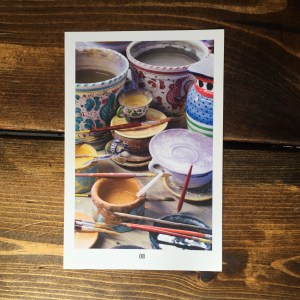
It, too, is messy. But it’s beautiful – one of those that deserves to have some sort of inspirational quote dancing across in scrawls and swirls.

I began to ask myself what the differences were between the two pictures of messy situations.

The dinner table signifies a mess that needs to be cleaned immediately. Eric and I have a hard time being able to relax in the evening if the kitchen is still a wreck from dinner, so he graciously does the dishes right after we finish eating while I put away leftovers. That picture also signifies that the fun has already happened; no one looks forward to cleaning up after a wonderful meal. That means the evening has ended and the fun is over.

However, the tangle of teacups and paintbrushes and dirty water notes that something special is being created. The artist might still be in the midst of the process, but there’s beauty in the middle of that mess. There’s promise that something special is being created, so that even when it is time to clean up, there is tangible evidence to add purpose to the mess.

I want to embrace life being messy with the view that it is producing something. I might still be in the middle of the mess, and the painting may be far from done, but there is something lovely about the process. Being messy, for me, reminds me that I don’t have the ability to put it all back together, and it therefore brings me to my knees more quickly in my need for God.

I am seeing that I cannot always wrap my arms around life and wrangle it in to my understanding or my control. Sometimes it’s wild and unorganized and uncertain. But in those moments, I can lean on a constant God for stability, embracing exactly where He has put me, trusting that He is creating something purposeful and beautiful.

His grace keeps me close when all else threatens to unhinge me. His grace teaches me to stay sane in the midst of messy. So I will embrace a messy life that carries the hope of how my God is at work and the promise that “He Who began a good work in [me] will bring it to completion” (Philippians 1:6).

I might still work to keep my home and my calendar pretty organized, though. Pretty sure that will help with sanity in the midst of life’s unpredictability.

if winter offers no answers

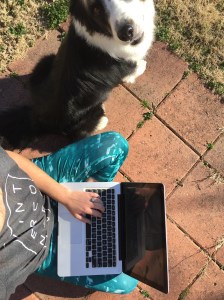
IMG_6099I lay down on the concrete, cat-like in finding the perfect spot for sunning in late January’s taste of spring. Ridley joins in as he perches beside me, scanning gaps between fence posts for signs of passerby activity.


My soul needed this weekend, as I am sure yours did, too.

In no time at all, the coats and gloves will stow away for the majority of the year. Tulips and daffodils will be the forerunners of Spring’s arrival, shooting through crunchy grass to trumpet her arrival.

After today, I expect Spring will hit the snooze button and fall back asleep for another six weeks, but her 65 degree stretch-and-yawn this weekend gives me just the hope I need – the reminder that winter doesn’t last for forever.

We all want that reassurance when we find ourselves in a season we would rather not remain in. Just a glimmer of what’s coming to give us strength to endure the winter for a little while more.

So what do you do when you don’t sense that glimmer, when the cold and gray envelopes you with no promise of letting go?

How do you find hope when none is offered? How do you live in the tension of what you are trusting is next and the reality of where you are right now?

I’ve struggled to write about this because I honestly don’t have the answer.

I’ve pondered and processed how to fight with hope against the cynicism of “it’s never going to happen” or “this is the way life will always be,” while also surrendering my heart to “not my will but Yours be done.”

And the best answer I have come up with is that it’s not a black and white thing, which is hard for me to accept – but which I am noticing the Lord wants to remind me of more frequently these days.

I am a self-aware legalist, thriving on rule-following and clear-coated ethics and knowing without a doubt that I am doing exactly what I am supposed to be doing. I am Nicodemus in John 3, asking the Christ for the 1-2-3’s on how to ensure my rightness with Him, finding the idea of “being born again” too odd and unattainable.

How can a man be born when he is old? Can he enter a second time into his mother’s womb and be born?

How can I trust You completely with my desires but protect against hurt? What is the secret to avoiding depression, grief, misplaced hope? How do I wholeheartedly follow You where I don’t think I want to go? How do I communicate honestly, tell You what I want, without being demanding or selfish or resistant to Your plan?

I am learning that my perspective, like Nicodemus’s, is wrong.

I so badly want to handle life “the right way” or “the way I should” that I miss the gift of God’s grace. I falsely think that spiritual maturity means growing to need God less and less the way we grow apart from our earthly parents – Look, Mom and Dad, I’m all grown up and filing my taxes without your help! However, I once heard someone say that spiritual maturity actually means that we grow to acknowledge our need for God more and more. It’s not about being able to stand on our own two feet but, instead, frequently falling in God’s arms and allowing Him to be our stable place, our rock.

He alone is my rock and my salvation, my fortress; I shall not be greatly shaken. (Psalm 62:2)

I am not shaken because of Him, not because of what I in myself am capable of.

I find my assurance not in how well I follow a checklist but in how well I know Him and accept His love for me.

So back to having hope but not being devastated in getting my hopes up.
To living in the tension of God’s goodness but God’s unexplainable purposes.
To how I am “supposed to” handle this spiritual and emotional season of winter.

I am humbly recognizing my need to let go of looking for the answers to my questions and instead look to the truth of Who God is, regardless of my circumstances. Not that He isn’t a God with answers, but sometimes He asks us to trust without the explanation we are looking for.

And He wants us to acknowledge that we are a mess and that we need His help, because, the truth is, we don’t handle life the right way. While I am feeling lost right now, I am taking comfort that He is present as I sort through what I don’t understand. His grace covers my continual shortcomings, my frequently incorrect thinking. His grace covers my pain and my lack of faith.

I am so grateful for this weekend, but I know that Spring doesn’t always show herself in January. When she doesn’t, when she remains in hiding, it doesn’t mean that she is no longer coming. It simply means we must continue to faithfully wait, trusting a Creator Who sets purposes in motion even if they are first buried beneath the surface of a frosty ground.

when you can’t skim over life

As a writer, there are two hard things I have found to be true. The first is that I can’t just write here about something that sounds good and spiritual and meaningful – I have to actually live it first.

The second is that as I, just like you, live through my own lessons and learn (often the hard way), I personally cannot process what I am experiencing until I write about it. Eric can normally start to tell when I haven’t written in awhile, because I complain about feeling “off” but I don’t know why. The way God has seemed to wire me to process by writing is something I love, but it also requires courage. Writing something down makes it feel more real, exposing pain and unfinished stories in which I could feel overwhelmed but instead am challenged to respond with truth about Who God is.

Very rarely do we as humans willingly embrace pain. We love the short cut and the easy way and the smart-enough-to-plan-ahead.

But the more I read the Bible, and the more I read authors who help me to read the Bible differently, I see pain laced in-between so many of the narratives. Where I once focused on the miracle at hand and the way God showed up, I am now slowing down the happily-ever-after I so love to celebrate and instead identifying with the characters, recognizing their pain in ways I have previously just skimmed through.

It’s so much easier to summarize the past than it is to live in the process.

Take Hannah’s story, for example. 1 Samuel 1 tells us, “Elkanah had two wives. The name of the one was Hannah, and the name of the other, Peninnah. And Peninnah had children, but Hannah had no children.” How much life is actually built into that blunt statement! We know the whole story – that God is going to show up and provide a son who will be instrumental in the shaping of Israel’s history. Knowing the whole story can cause us to keep reading to get to the good stuff: the angel’s promise, the answered prayers, the boy who would later audibly hear God’s call. But Hannah didn’t have that advantage. Day in, day out, Hannah lived through this harsh and constant comparison, uncertain of her future and of her God’s plan.

The death of Lazarus, Mary and Martha’s brother, is another happy ending we can gloss over too quickly. The whole story is in John 11 but basically Mary and Martha send a messenger to Jesus to ask Him to come heal their brother, who is sick. Jesus somewhat cryptically responds, “This illness does not lead to death. It is for the glory of God, so that the Son of God may be glorified through it.” He then waits before going to visit this family, and by that time it is seemingly too late. Mary and Martha have been mourning their brother’s death for four days. What do you think those four days were like for Mary and Martha? If you have had a loved one pass away, what were the first few days like for you?

When Jesus finally shows up, Martha runs out to greet him, but Mary doesn’t leave the house. When someone comes to tell her that Jesus is calling for her, she runs to Him, falls at His feet, and wails, “Lord, if you had been here, my brother would not have died.”

We know Jesus is about to do something great. But for the past four days, I bet Mary was lost in grief. She knew Jesus’ authority and power, yet she and Martha waited and waited and He didn’t show up.

We don’t get to read ahead in the story of our lives to see how God is going to act or what He is doing ultimately for His praise from our lives. We have to live each day in uncertainty of the future, certain only that life doesn’t always go the way we hope it will. There is an ultimate happily ever after when Jesus comes back for good, but until then we are surrounded by brokenness.

The sweet thing I am noticing in the midst of the pain is the way that pain draws a person into deeper intimacy with God – and, in my recent studies, especially in examples of women in Scripture. We don’t read a lot from the perspective of women in the Bible, but often in the times that we do, there’s a desperation present in their need for God to show up. We get to see Hannah praying so intensely that the priest Eli thinks she is drunk. We see Mary fall at Jesus’ feet and audibly question what He is doing. At the end of Genesis 29 we are privy to Leah’s heart as she names her sons to reflect her own pain of being unloved – and as they reflect her transition over the years from craving her husband’s affirmation to being able to praise God despite her marriage reality.

It’s a beautiful picture of the Gospel, our desperate need for God and His grace to meet us in our lack.

IMG_6075

In When Life and Beliefs Collide, Carolyn Custis James writes (referencing Mary’s interaction with Jesus after Lazarus’s death):

Jesus does not stand above or outside of Mary’s pain, much less urge her to snap out of it. He is neither philosophical nor patronizing… He acknowledges her sorrow and validates her suffering by entering himself into the full measure of her distress without reserve. Surely Jesus’ behavior should prevent us from ever thinking good theology makes us impervious to our pain or indifferent to the suffering of others… Good theology ­– in Jesus and in us – coexists with broken hearts, shattered lives, and unimaginable pain.

Jesus is with us in pain. He doesn’t chide us for being overwhelmed with sadness as we walk through the hard seasons of life. Faith in Him doesn’t mean that we are able to endure trials personally unaffected by what’s happening; faith is experiencing the grit of life and crying out against it yet still choosing to cling to Him in the midst of the unexplained.

In another book, The Gospel of Ruth, James comments, “God uses suffering to open our eyes to see more of him than we would under rosier conditions.” How my heart longs for my own eyes to be opened in such a way – to not skim over pain in hopes that it will be over soon, but to walk each step looking to see more of God through my sadness than maybe I could if everything went the way I wanted it to.

One of the blessings as I am walking through the unmet desire of pregnancy and a baby has been the reality that I can’t share my story or even how I am doing right now in that skimmed-over fashion I might normally use. It’s easy to tell others how God has worked in my life in the past now that I can connect the dots and see what He was doing. In this moment, though, I don’t see the full picture. I don’t have the promise of a pretty bow to tie it all together. What I do have is the confidence that He is present, even in the midst of sorrow, and I am grateful for a platform that allows me to put what I believe about God to work. I pray that the way I am daily living in this season, though imperfect, is an encouragement to others who will one day – or who, even now – walk through their own trials and broken places.

This unavoidable brokenness is a reality that we live in the process, but we can and must cling to truth in the midst of the day to day: He is with me. He is for my good. He is for His glory. And those truths are worth more than just being skimmed over.

a prayer for rooting

Fingers dig in dirt, nails catching bits of earth and scattering worms.

Roughly, with quick and precise movements, You snag weeds away from my growing root base. Weeds of fear, of anxiety about the future, of doubt. These I know exist and need to be taken. But You also find weeds of idolatry and of misplaced hope, and these hurt a little more as they are ripped from their interwoven-ness in my own growth.

Lord, this year, I want to focus on being rooted in You. I want to find myself established and firm in good soil, holding fast even as winds and storms tangle my branches. Seasons change and with them, so does the appearance of the tree. Yet the roots can remain healthy and deep, promising new life in turn.

I confess I have too closely connected with weeds lately.

I have listened to their whispers, allowed them to plant themselves too close to my own growth, and I now recognize them for what they are: false and dangerous, lies seeking to inhibit my own health.

I pray that You would regularly weed this soil, continually remove the lies I have given in to and nourish my soul with the truth of Your Word. Cultivate my surroundings. Keep me thirsty for the nutrients only You can provide.

Oh Lord, no matter what lies ahead, I want to cling to You the way my roots snag dirt. Whether ahead lies a wet and sunny spring or a cloudy, extended winter, I trust that You know what I need to grow. You can do the work of bearing fruit in me; may I simply surrender to Your sovereignty.

You, Who controls the wind and the waves and the storms, can control the health of the tree, despite what’s going on around it.

You, Who controls the universe, can be trusted with my future.

So I pray that, no matter what lies ahead in 2016, You would root me more deeply in Yourself, so that I may grow and flourish because of Your care.

Psalm 1:1-3
Blessed is the man
    who walks not in the counsel of the wicked,
nor stands in the way of sinners,
    nor sits in the seat of scoffers;
but his delight is in the law of the Lord,
    and on his law he meditates day and night.

He is like a tree
    planted by streams of water
that yields its fruit in its season,
    and its leaf does not wither.
In all that he does, he prospers.

the story isn’t over yet

Have you ever had the thought, “What if this is the way things will always be?”

So often, especially when we find ourselves in a season of waiting, we start to think things will never change. Like a week of rain and gray skies causes us to forget how a clear, sunny day feels on our skin. Like the way fog settled in over Mount Rushmore just before my friends and I arrived, made us wonder if the carved rock faces actually existed behind all those clouds. Obstructed or incomplete views have a way of causing us to doubt that the picture will ever be whole.

Misplaced hope keeps us thinking that things won’t be better until our circumstances change. Discouragement, if left unchecked, can lead to a paralysis – an inability to look up from the ground we are staring at as we walk. And when we lose both hope and the ability to think about more than what’s directly in front of us, we might think the story is over.

I remember exactly where I was when I saw the Facebook Messenger notification.

Eric and I had just landed in Seattle after leaving Juneau early in the morning, on our way home from the Cru Summer Mission we were staffing this past summer. I was waiting with our luggage outside the bathrooms and checking my phone after having it turned off for the flight. I was startled to see a message notification from an elementary and junior high classmate whom I had not spoken to probably since 2003 or 2004. Moreover, we weren’t necessarily good friends. In a small school, you were “friends” with everyone, but this friendship involved a lot of turmoil and hurt.

Any time I share my story with new friends or with college students, a prominent area in my life where I explain God’s hand at work is my struggle with healthy friendships in my growing up years. I felt very lonely in junior high and high school (due to many circumstances, not just this one relationship), and some dramatic seasons in our junior high class of 20 or so students led to personal struggles with insecurity for the next several years. However, I also share in my story that God used these times of isolation to draw me closer to Him. I felt like I couldn’t depend on the people around me, but I learned that God was constant and loving and faithful. He helped me to develop an identity apart from people, and I learned to fight the thoughts of insecurity. My parents prayed with me all through high school that God would prepare good, spiritually-encouraging friends in college, and He blessed me in incredible ways in this area once I stepped foot onto the University of Arkansas campus.

However, the story is never over.

This friend was contacting me to apologize – something I never would have expected. She shared with me how God had worked in her life over the past several years and how He had kept me on her heart and she felt like she needed to ask for my forgiveness. She worried that she would be opening old wounds by contacting me, but really felt like she needed to reach out to me.

My breath caught in my throat as I read her words. What kind of amazing maturity and life change does it take for someone to apologize almost 15 years later?!

God had worked in me years beforehand to help me let go of the pain and use the story for His glory, to connect to other women who also struggle with friendships and letting go of hurt, so I shared with her how God had used the situation in my own life for development and in others’ lives for His glory. I also apologized for ways I most likely handled it the wrong way, letting jealousy get the best of me — and just like that, I had a new friend.

Now, I have a new facet of my story to share with others: God is always at work in the redemption process.

We can’t always see what is going on in the other side of the story. God was reaching this friend in one way with her bullying and He was reaching me in another way with my insecurity – and, honestly, He was pruning out some self-righteousness as well. He was at work in both of us – but we weren’t at a place to see that yet. Now, though, we both have the joy of seeing a new perspective in God’s faithfulness to use our mistakes for good.

Let this encourage you, friend: Your story isn’t over yet.

Whether you are wrestling with pain from someone close to you, or recovering from the death of a loved one, or walking through discouraging job situation, or waiting for God’s provision in a spouse or a baby – this isn’t the way things will always be.

Not that you will get exactly what you want. Not that life circumstances will change to line up with our plans. But our hope is not in the change in our circumstances but in God’s faithfulness to continually redeem this broken world for His purposes. We can trust that even after 15 years, He can bring clarity to the story and He can open up new understandings in which our only response is to fall at His feet and praise Him for how good He is.

He is still changing you and me, and often His method is to use our life circumstances to refine us. Psalm 66:10-12 says,

For You, God, tested us; You refined us as silver is refined. You lured us into a trap; You placed burdens on our backs. You let men ride over our heads; we went through fire and water, but You brought us out to abundance.

He is at work to bring us into the abundance we experience when our hope is fulfilled in Him. He is perfecting us through each situation (James 1:2-4), and even when it feels like we don’t know where He is or how He could be present in the situation, “He knows the way that I take; when He has tried me, I shall come out as gold” (Job 23:10).

Wherever you are today, don’t give up. Your story isn’t over yet.

joy in advent’s dependency

We cut down a Christmas tree and decorated it two weekends ago. I decked out our new mantle, as well, with red and black plaid ribbon woven into a cheap fake garland (ribbon added to hopefully make it look less scrawny). Christmas music is a background soundtrack each evening, and in that sense I feel “ready” for the holiday.

FullSizeRender (1)

In a deeper sense, though, I am ready for advent.

Advent feels sweeter to me this year, and I don’t know why, other than crediting the Lord for preparing my heart for this season. In the past, I have loved the idea of being intentional to celebrate Advent with devotionals and candles and liturgies. And yet I always look back on December wondering why it wasn’t as spiritually enlightening as I wanted it to be.

But this year, I find myself longing to move from idea to experience, to savor Christ in a season all about the longing and the wait.

The longing for what is coming but is not here yet.

As I dive into Scripture this month, I more clearly notice the yearning and the groaning of Israel for redemption, which has been promised throughout the Old Testament. A Redeemer to bring peace to a nation whose history has been riddled with conflict and exile and rebuilding and darkness. A Rescuer to provide salvation. A Righteous Ruler to restore what has been broken.

In Advent, we focus on the coming of Christ, waiting for the celebration of Christmas as the Israelites waited for Jesus’ birth, then as they (unknowingly) waited for Jesus’ death. We also find ourselves still waiting for Jesus’ return and the total fulfillment of this broken world being redeemed.

Advent has been fulfilled and yet – in another sense – has yet to be finished.

And as we wait for the redemption of this world, we experience hurt and sorrow and unmet desires. John Piper said, “God prepares a person to receive Christ by stirring up a longing for consolation and redemption that can come only from Christ.” It’s easy to look around at the world around us and recognize that things aren’t as they should be, and the hard yet beautiful thing about this is that it draws us to a deeper place of aching for Christ’s return and rescue.

Something I am appreciating about waiting is that it forces me into an awareness of my dependency and my lack of control.

In waiting, we declare a dependency on something or someone else.

Waiting takes place when we have a goal or destination but something is preventing us from getting there. Whether it is waiting in traffic on I-49 after work or waiting for a new job or waiting to get married or waiting for your marriage to get better, there is some factor outside of our influence that causes a delay.

{This is going to get personal.}

We are waiting to get pregnant. Have been “trying” for eight-ish months at this point. I quote-unquote due to the odd terminology of the verb “try” for the desire to start a family. From our experience, so far, I am realizing that it is less about trying and more about giving God an opportunity to work, because trying indicates a level of control I have realized we don’t actually have.

While I have hinted and briefly mentioned examples here previously, I haven’t wanted to incite sympathy for this current path we are walking. I have wanted to avoid people responding to my words with advice on what we should change to make conception easier, or in response have you experience a saddened emotion when you think about the Barneses. Because, as it is, I feel joyful when I think about what God is doing. And I love even getting to celebrate with friends who are getting pregnant.

Because, while it honestly is in the front of my mind a lot, our story is much bigger than that desire.

During Advent, as I have reflected on waiting and longing and the lack of control, I have experienced an incredible peace with our circumstances. Emmanuel, God with us, has felt so tangible to me. This doesn’t mean that I haven’t experienced sadness. In fact, for someone who is way more “thinking” than “feeling,” the sadness has been one of the hardest parts for me to manage. I have always thought that, if I trusted God, my emotions would agree, and I wouldn’t be sad.

But here I am, trusting God fully, yet more prone to weepiness than I ever have been. I normally have to understand something in my head before it reaches my heart, and this I don’t understand. Thankfully, I have enough “feeling” friends in my life who have helped me process through this and have validated me, relieving a fear I think I have unconsciously had in the past that feelings can’t be trusted.

In Advent, I am understanding the phrase used in Luke 2:25 where it says Simeon was waiting for “the consolation of Israel.” I am longing for the comfort, like John Piper said, that only Jesus can give. While I don’t expect God to always do what I want, I have experienced His consolation as He walks with me through every trial, every situation – including the unmet desires of my heart to start a family.

As we wait for our circumstances to change – and as we ultimately wait for Christ’s return – God walks with us through the wait. He reminds us that He is trustworthy and He is faithful to His character. It took several hundred years before the prophecy of Christ was fulfilled, so we know God has His own timetable, but we also know that He sustained the nation of Israel during that time. He will sustain you, too.

And while He may not answer your prayers in the way you want Him to, He will answer. He will show up. And He will use you in His grand story to make His name great.

So as you walk through this month of anticipation for Christmas and all that Christ’s coming means, think about what you are currently waiting for in your own life – then confess to God that you relinquish control to Him, because you ultimately can’t solve it anyway. Allow your wait to draw you into a sweeter dependency on Him, and expect Him to be present with you as you wait.

discovering that ridley and I both hide in the closet

It’s been a dark, stormy day here – the perfect kind of day for continuous mugs of hot tea and books read under quilts and new words tripping across the computer screen. The gutter outside my window hums, and I can tell by the ripples in street puddles that the drizzle is still going.

Our cowardly pup hides in a dark closet. Eric slipped the dog bed in there this morning before he left for work, knowing that Ridley would seek refuge there (that is, after he learned that I would ignore his pestering paws begging to join me on the bed).

FullSizeRender

There are days when my heart acts in the same ‘fraidy manner, cowering in a closet to shut out the storm. 

“Hope” has been a confusing word for me lately. I don’t quite know what to make of the concept. I am certain that we are called to place our hope in God, not in our circumstances, but translating that into real life has felt fuzzy. How do we hold onto hope in the midst of disappointment? How do we believe that God is able to do what we ask, yet not be devastated when He chooses to answer differently?

Connected to wrestling this idea of hope is wrestling my understanding of God’s promises. We are told to remember God’s Word, to call to mind His promises, yet we often unintentionally manipulate those promises to be self-beneficial. We forget to take into account correct context and the fact that many other places in Scripture state that, as Christians, we shouldn’t expect an easy breezy life.

But how do we hope for answered prayers in the midst of the trials we know we will walk through?

I read a really sweet blog post about the experience of walking through the wait for pregnancy. The writer spoke of her dreams for what that season would look like, and what realities she knew to expect, and the presence of God in the midst of her pain. But one statement stood out to me in a way that made my heart hurt. She referenced the prayers Hannah was praying for Samuel and said that in the midst of pain, we should whisper our own prayers for our promised one.

And this statement hurt because I knew it wasn’t true.
My “promised one” isn’t a reality.
God hasn’t promised me a child.

I am sure this writer had good intentions, and she may not have realized her error in thinking, but God hasn’t promised any of us a healthy pregnancy or a dream job or financial security or a successful marriage.

Hannah prayed earnestly for a child – so earnestly that the priest Eli thought she was drunk. When he spoke with her and heard of her sincerity, he blessed her by saying, “May God grant your petition.” She left the temple still having no promise from God about her request, no timeline with which to set her expectations. The Bible then tells us “in due time” that Hannah conceived — but not necessarily immediately. Certainly not in the timing she wanted. Hannah prayed earnestly, in hope, without guarantee that her prayers would be answered in the way that she desired. 

We read Jeremiah 29:11 and cling to the “promise” that God has plans for our success and prosperity, not realizing the context of this verse relates to God telling the Israelites (through the prophet Jeremiah) to settle in during exile, because they will not be leaving in their lifetime. The Israelites found themselves dealing with the hope that rescue was on the way but at the same time grief that they wouldn’t experience that rescue the way they were hoping to. Their rescue did come, but it came in the form of God’s presence with them while they remained in a foreign land among a pagan people. Sometimes that’s how our rescue comes, too.

Shadrach, Meshach, and Abednego hoped in God, knowing He was capable to save them from the fiery furnace but also acknowledging He might not choose to. “Our God whom we serve is able to deliver us from the burning fiery furnace, and he will deliver us out of your hand, O king. But if not, be it known to you, O king, that we will not serve your gods or worship the golden image that you have set up” (Daniel 3:17-18). Tim Keller commented that, essentially, these three men were saying, “We serve and love God for Himself and not what we get out of Him.” 

And that is how I want to rest in God’s promises.

My hope is found in Who He is, not in what He can do for me. And when I fix my eyes on Him, I find that He is true to all of His promises concerning Himself — regardless of our circumstances, His character remains certain.

He is a God of unconditional love – a love I cannot understand, cannot mimic, cannot describe. (1 John 3)

He is a God of grace, undeserved favor, sufficiency to walk through the fiery furnace. (2 Corinthians 3:5, 12:9)

He is a God of presence, Emmanuel. He walks with me in the midst of trials. (Isaiah 43:1-3)

He is a God on our side, telling us to approach His throne with confidence because Jesus intercedes for us as our better high priest. (Hebrews 4:15-16; 7)

He is a God with a plan for His glory, and even if we can’t see the full picture, we can trust that His “working all things together for good” has more to do with His purposes, with an eternal perspective and a “good” that is beyond our earthly definition or understanding. (John 12:27-28, Romans 8:28)

Going back to hiding in the closet —

I confess I still don’t quite know how to manage the balance of hopeful expectation in what God can do and what He actually chooses to do. I don’t know what I should be feeling as I pray in expectation but also pray in surrender.

But the dark closet is where I find myself waiting, and the more I fix my gaze on truths about God, the less I fix my gaze on myself, my plans, my wants. The more I look for His presence, the less aware I am of the storm outside. My joy comes from His presence and not from my circumstances.

Ann Voskamp writes about hoping instead of giving up and uses the image of the planting of flower bulbs in late fall.

“No!” Little One wails. “Don’t put the flower so far down in the dark!” She tries to wrest the bulb from his hand. I scoop her angst all up close.

“But it has to go down in,” I brush the hair out of her eyes, kiss tip of that pug nose. Because sometimes, Child —  hope’s waiting is dark.

She turns her face up towards mine and our cheeks brush.

“Will we have to dig them up to get the flowers after the snow?” I squeeze her tight.

“No, Girl. When He’s ready — all that beauty will come up through the black earth as if by themselves.” […]

We bury hope in a tomb of its own.

Like the faith diggers do every day. We bury our swollen prayers in Him who’s raised from the tomb.

We lay our hope, full and tender, into the depths of Him and wait in hope for God to resurrect something good.

Good always necessitates long waiting. […]

Every person needs hope planted at the bottom of their hole.

Because that is the thing:

Hope is what holds a breaking heart together. 

Hope in a Big God is what frees from big fears.

Hope is a thing with keys…..

And we live in wait —

because there’s an old and steadying wisdom cupped in the curve of just those two words, ‘Hope and Wait.”

“And we live in wait.”

Because He Who promised is faithful, and He will surely sanctify us as we wait (1 Thessalonians 5:24).
Because He longs to be gracious to us, though we may not understand His timing (Isaiah 30:18).
Because He is the type of God who uses periods of trials, of the wait, to refine us like gold (Job 23:10).

How can you approach God in confidence of Who He is, not looking for what He can do for you but simply knowing Him for Himself?
What truth do you need to believe about God regardless of how He answers your prayers?
How does He fulfill promises of His character in your everyday life?

willing to remain in the fog

It’s a perfect fall morning for the porch swing, a jacket, and a cup of hot tea.

I suppose that most mornings in this house have felt perfect for enjoying the front porch, ever since we moved in mid-April. The dog most always joins me here, sunning himself on the concrete or taking careful watch for lizards. Here is my favorite writing spot. Honestly, I started a blog back in college just to write for myself. I have found that, as a writer, I write to process and discover and hear from God. I hit “publish” in case God wants to use these words to encourage someone else, but the main reason I write is for what it produces in my own life. I learn as I see the words scrawl across the page, connecting my head to what’s going on in my heart.

However, the past week or so, every time I have attempted to write, I have felt paralyzed by something unknown. I haven’t felt like myself, perhaps due to not being able to translate all that has been going on in my head into written words. I’ve been distracted, which is why this was originally written pen to paper – a notebook leaves no opportunity for social media or comparing what others have written to my own meager space in this corner of the internet.

I have felt like I am in a sort of a fog that is not clearing — and frankly, it’s frustrating.

I know I won’t always be able to see down the road and envision what’s ahead. But it’s been difficult not being able to clearly look back at where I’ve been, either. The past can at least give some clarity that I have moved forward, that progress has been made or growth has occurred. But even that feels like a blur to me right now.

I can feel myself struggling, wrestling with the Lord, begging Him to clear the fog.

If I am in a season of waiting, I at least want to know what the purpose is. I want to figure out how to make the most of it and how to enjoy it.

What do you have for me, Lord?
What should I be doing?

“Just wait,” He tells me.
“Stop trying to figure it out. Stop squirming. Be that contented weaned child in Psalm 131.”

Life feels hazy for me right now. Maybe you are there, too. One of my college girls recently realized that her plans for after graduation needed to change, though not for a clear replacement or compelling purpose. Her future feels more uncertain than ever as even graduating on time seems like less of a possibility. She struggling, too, to process the “whys” and the “what nows.”

We like to have answers, and if we don’t have answers we at least like to be in the problem-solving process.

But maybe God is calling us to just be in the fog. To acknowledge the lack of clarity and the fear of not being able to see in any direction, and to be okay with that.

Maybe God uses the fog to keep us present.

Without increased vision, we can’t compare our surroundings to that of someone else, or even to our past self. When we can’t see, we can’t wish we were further ahead because we don’t even know what it looks like yet.

The fog forces me to be “all here.” It reminds me that I can’t change my surroundings, and it increases my trust for all that I cannot see.

And, when I stop to just be present, I realize how beautiful the fog is. It seems to be God’s way of making the present feel more magical, and I find it more enjoyable to not see what’s ahead when I look at it from that perspective. I can see myself in a fairy tale story, and I can then recognize the ability of the Author is more important than the character’s understanding of the plot. The Author will get her there in the best way, because He is the One crafting the story.

There’s beauty in the unknown.
Don’t miss it.

a list for those still looking for mr. right

As Eric and I approach our fourth wedding anniversary (November 6!), I have been reflecting on what I’ve learned over the past four years as a wife. “Healthy marriage” has become a passion for both Eric and I, as we could spend all day talking about what we’ve learned (typically the hard way) and how we have seen the Lord use our relationship to refine us individually and refine us together. We love having the opportunity to pour into younger couples and to pray for our friends in their marriage relationships and to spend time learning together how we can continue to grow in this relationship that is ultimately meant to reflect God and His relationship with His people.

When you realize the ultimate purpose of marriage, you should recognize a certain weight from what you have entered into with your spouse. It’s more than just a piece of paper signed by the two of you and an officiant – marriage is a holy covenant and a ginormous responsibility and a wonderful privilege.

As a wistful, wishing teenager, I remember reading books that talked about making lists of the qualities I wanted in a future husband. I confess that I loved daydreaming about being married to Prince Charming one day, so I would fill journals with my hopes and dreams for what he would be like and what fun things we would do together and what I expected marriage to be like.

But looking back, I see a certain danger in this practice. Yes, it was good to think through my standards and prevent against falling for the wrong guy, but I think it can also prevent falling for the right guy if you set unrealistic expectations. I should have spent time talking to married women in my life who could tell me what was actually important in a marriage as opposed to my looking to romantic comedies and classic novels and trying to pull out all of the characteristics I liked about the heroes of my favorite stories.

When Eric and I first got to know each other, I didn’t think he was right for me. I had always pictured myself with someone loud and outgoing to match my own personality. I thought it would be a man who was strong-willed enough to prevent me from running over him, which I had been told by many people was a must due to my own strong tendencies. I was extremely active in high school and college playing sports, and I pictured playing ultimate frisbee or softball with my husband, maybe coaching a kids’ soccer team together one day. And as wonderful as I knew Eric was, I didn’t see these qualities in him. He didn’t meet the expectations I had set for myself as a fifteen-year old, so I felt like we didn’t “click” and I needed to keep waiting.

Six months later, when the man didn’t stop pursuing me, I began to realize I was wrong. His introverted nature and calm demeanor have since softened my rough edges, and he keeps me from running myself ragged always trying to be busy. I have learned the beauty of reflection and of quiet moments in my day. He might not be the strong-willed man who can overpower me, but instead he has the desire to lead me in love, which in turn challenges me to give him space to lead and to teach myself to not be in control. He’s a cyclist, a sport I never really thought about but now appreciate (not only because it’s less impact on my knees and feet, but also because it keeps him in pretty great shape ;) ). I still get to be active with him on bike rides and walks and the occasional run with the dog, which are activities that will last far longer in life than my ability to catch a frisbee or shoot a layup.

Bigger than these things, though, I have learned more about the character traits that are important in a husband and in a marriage. Most of these have become clear as we have walked through life together and had to process unexpected or unchartered experiences.

So for you, dear reader who might be single or dating, let me share with you some of what four years of marriage has taught me when it comes to looking for Mr. Right. 

  • A growing relationship with the Lord on his own. He can’t be going to church or attending a Bible study just to please you; the authenticity of his walk with God will impact every single area of your marriage, from how he makes decisions to how he handles finances to how he forgives to how he serves to how he responds to his mistakes and your mistakes. It’s okay if he’s not there yet — none of us ever “arrive” when it comes to spiritual maturity — but you should be able to tell whether or not he is growing. And as he grows in the Lord, it should push you to also grow spiritually, to dig more into intimacy with God. Through Eric’s relationship with the Lord, I began to understand a new perspective  on how to walk with Him and relate to Him, and he pushed me to go deeper.
  • Involvement in community with other believers. There’s the cliche about no man being an island – and it’s true. As women, we know we have a strong need for relationships and for deep conversations, while it can be a harder need to recognize in men. Eric is typically pretty content to come home and just be with me. However, I can tell that Eric is at his healthiest when he is getting regular time with other men, both in his season of life and those ahead of him or behind him. This community keeps him accountable, as well as reminds him that he is not “the only one” who is struggling with work or with something in marriage or in his spiritual life. Especially after college, friend time doesn’t come as naturally, and it requires much more initiative than it did when he was in class or eating in the cafeteria with other dudes.
  • Good reputation and respect among peers. This was one of the first things that stood out to me about Eric Barnes. When he introduced himself to me, I knew who he was because I had heard other men mention his name. After he asked me to formal, I had several people come up to me and say, “I heard Eric Barnes asked you to formal! He’s such a great guy.” You want someone who is respected among people, not someone that people make fun of or don’t take seriously at the appropriate times. You don’t want to have to convince people of his character or defend his intentions; when you get married, you and your husband are “one,” and whatever is his reputation will typically be attached to the both of you.
  • An attitude of learning. Don’t look for Mr. Perfect. Look for Mr. Willing-to-Learn. The elusive “they” tell you that the first year of marriage is the hardest, and I believe this is true in the sense that it’s exhausting to constantly encounter new situation after new situation: What do we do for a phone plan? Who will pay the bills? How do we handle holidays? What do you need when you come home from a bad day? What annoying habits do I have that you now have to put up with? Are we going to move or stay put? I can only anticipate what new things we will need to learn one day when we have kids and have to learn how to parent. I am so grateful that I married a man who constantly wants to learn not just how to do life with me, but also how he can improve (especially as our situations change).
  • Humility. This relates to an attitude of learning, but it also relates to how he handles the authority in his own life. Is he willing to obey God even if it’s a hard decision? Does he even go to God to ask for wisdom? Does he have a mentor whom he respects, or does he criticize anyone who tries to counsel him? Humility also affects how quick he is to forgive and forget. A humble man doesn’t hold grudges or feel that he should be righted for whatever wrong was done to him, whether by you or anyone else.
  • Aware of his weaknesses. Eric has learned what things he is good at, and consequently which areas he is most likely to struggle. It’s such a joy for me to come alongside him in his weaknesses, as he does in mine, and we find our rhythm best when we are honest with ourselves in the areas we will probably need help. A man should know in which areas he struggles with self-control, and he should have accountability present (typically not you) when it comes to not allowing himself to be dominated by work or by a hobby or by food/alcohol.
  • Speaks well of you in public (whether or not you are present) and saves criticism or questioning for private. I am so blessed by a man who does this well. I have never felt shamed by him or made fun of (beyond appropriate teasing) in front of people I know or even don’t know. When we get together for his work Christmas party each year, one of the first things new people I meet tell me is that they have heard so many good things about me. Now, I am far from perfect, and I often speak without thinking, but Eric is always careful to be gracious in how he handles those situations. He doesn’t go into work in the morning complaining about the argument we had or the plans we disagreed on over the weekend. This is so valuable, and a habit that I pray I cultivate as well.
  • Affirming of you. Eric praises me in public, but he also praises me when no one is around. Even if we need to have a discussion on a way I could change or be more considerate, he is careful to also affirm me in other areas of our relationship. He affirms my passions, my dreams, my appearance, my cooking, my work to run our household, my ministry, etc. etc. I feel confident that he supports me in any endeavor I attempt.

I could go on, so please don’t take this as an exhaustive list. However, these are character traits that should be evident in a man’s life before you get married. Putting a ring on a man’s finger won’t change him, as much as you might hope it would. Marriage is less about changing a person into a good husband and more about the two of you growing together in maturity, in life experience, and in the Lord. 

You won’t marry a perfect man. You probably won’t even marry a man who hits every single ideal on your list. But, if you marry a man who is godly and teachable (and you yourself are godly and teachable), it will make all the difference for the rest of your life.